


How does a double roller granulator work
You can convert fine powders into high-density granules using powerful mechanical compression. A double roller granulator squeezes low-moisture raw materials directly between two counter-rotating rollers. This dry process completely eliminates the need for thermal drying equipment.
Energy Efficiency Note: Operating at normal room temperatures allows you to save substantial energy compared to traditional wet granulation systems.
Fertilizer manufacturers and plant operators gain a highly efficient solution to produce strong, uniform granules continuously.
Key Takeaways
Double roller granulators squeeze dry powders into hard granules without using heat or water.
You save up to two-thirds of your energy costs by skipping the thermal drying process.
Hydraulic controls let you easily adjust roller pressure to create different granule sizes.
Two crushing stages reduce thick compressed sheets into smooth, uniform fertilizer particles.
A built-in recycling loop reuses fine powder automatically to eliminate raw material waste.
Raw Material Drive and Feeding Mechanism
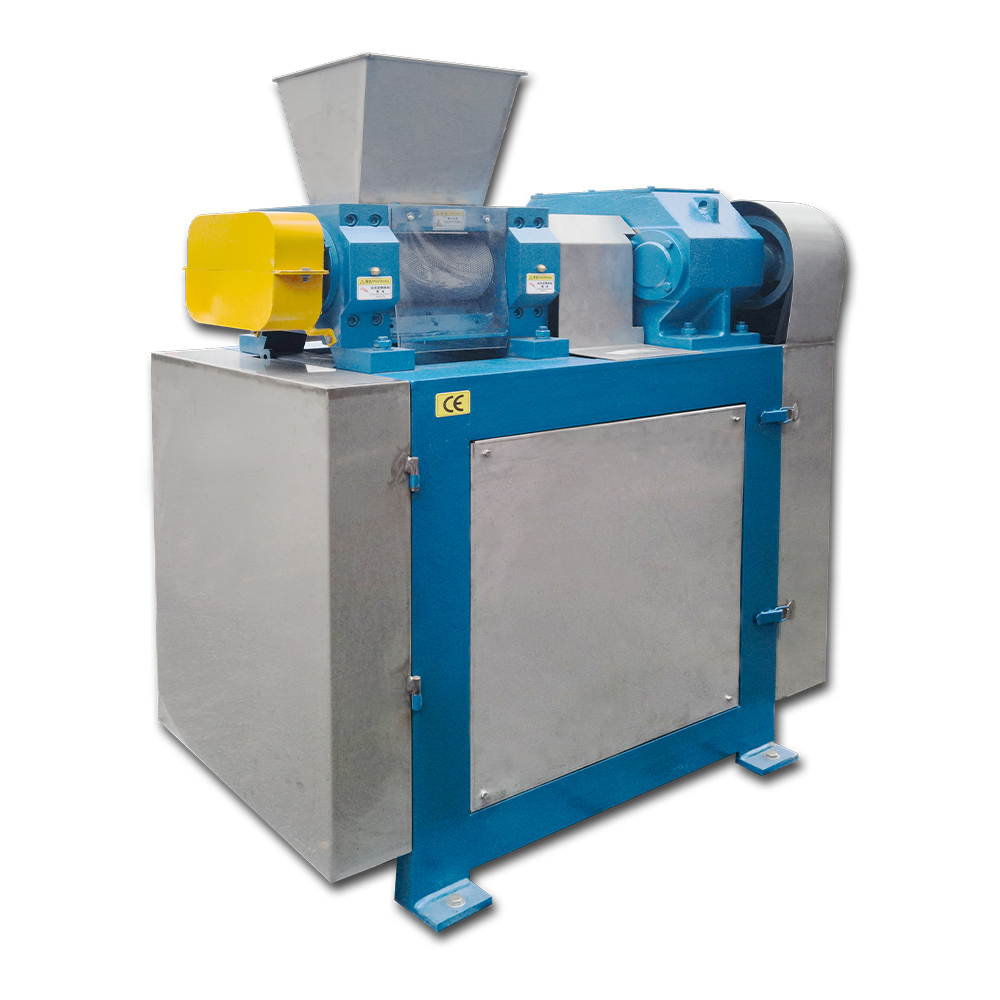
A successful compaction process begins with precise mechanical control and steady material delivery. You need a strong power system and a consistent feed to produce dense, high-quality granules.
Motor Transmission and Reducer Drive
An electric motor powers the mechanical drive system. The motor transfers rotational energy directly through a v-belt and pulley setup. This initial transfer absorbs operational shocks and protects the electrical components from sudden loads.
Next, the drive shaft connects to a heavy-duty speed reducer. The reducer converts high motor speeds into high torque at lower RPMs. This mechanical advantage provides the immense force necessary to compress raw powders. Dual shaft couplings then split this mechanical power to drive two synchronized main shafts, turning the heavy compaction rollers toward each other at identical speeds.
Component | Primary Function |
|---|---|
Electric Motor | Provides initial rotational energy |
Belt & Pulley | Absorbs mechanical shocks and reduces vibration |
Speed Reducer | Multiplies output torque and lowers rotation speed |
Main Shafts | Rotates the compaction rollers synchronously |
Continuous Hopper Feeding and De-Aeration
You load your dry or low-moisture powder into the feed hopper located directly above the rollers. Gravity and internal feeding augers push the loose material steadily down into the compaction zone.
Pro Tip for Consistent Density: Removing trapped air from fine powders prevents air pockets inside the extruded material, giving you harder flakes.
As the powder moves downward, forced de-aeration channels allow trapped air to escape upward. This air removal increases the bulk density of the material before it reaches the rollers. The double roller granulator accepts a tight, continuous stream of pre-compacted powder, ensuring smooth operation without material bridging or slipping.
Double Roller Granulator Compaction Process
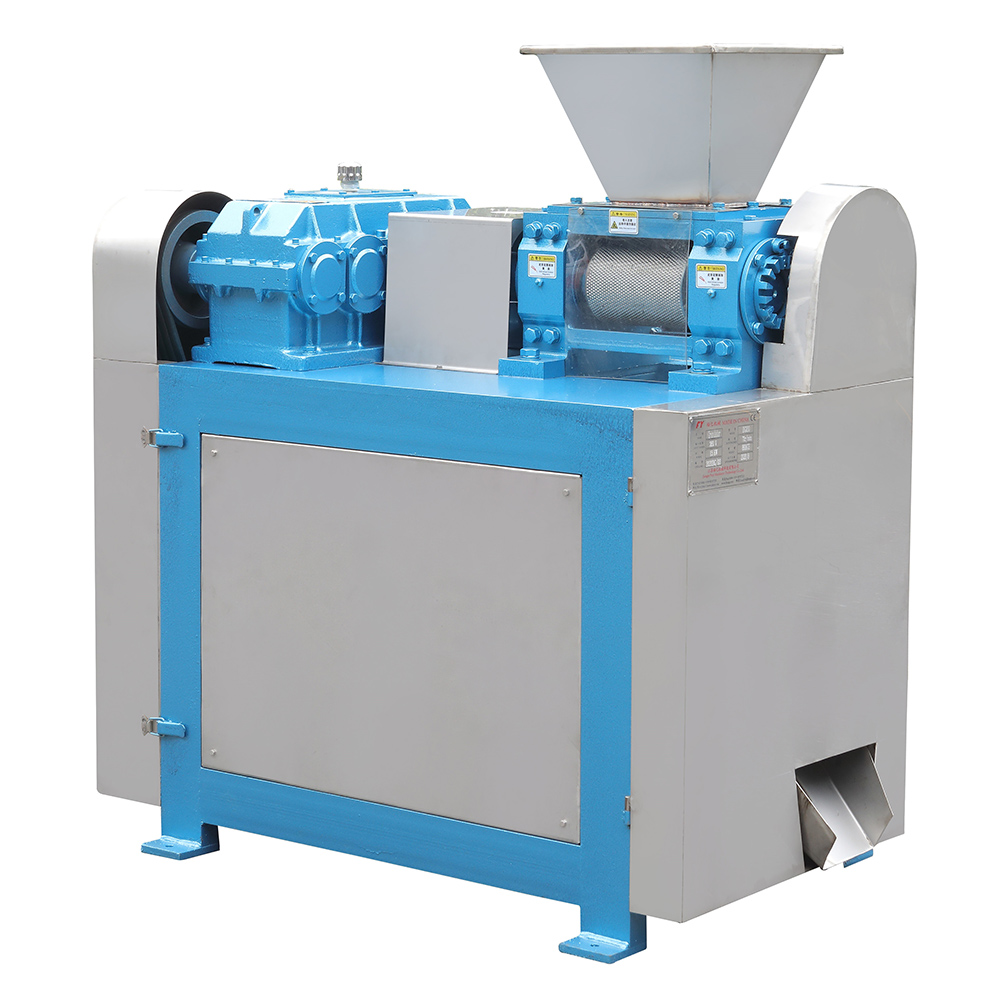
High-pressure compression drives the entire dry granulation cycle. The DG Series double roller granulator by Jiangsu Fuyi Machinery Technology Co., Ltd. sets the industry benchmark for high-efficiency compaction. You convert loose powders directly into dense, hard solids without using water or high heat.
Counter-Rotating Alloy Steel Rollers
Two synchronized heavy-duty rollers sit at the core of the machine. These rollers rotate toward each other at identical speeds, pulling loose raw material continuously into the narrow gap between them. The rollers squeeze the powder with tremendous mechanical force as material enters this compaction zone.
Forged alloy steel forms the outer body of each roller. Specialized heat treatments give the surface extreme mechanical strength. You can also select optional hard chromium plating. This protective coating stops corrosion from harsh chemical compounds and shields the roller surface against abrasive fertilizer powders.
Specification Parameter | DG-200 Model | DG-300 Model |
|---|---|---|
Drive Power Requirement | 15 kW | 30 kW |
Production Output (Oblate) | 900–1,300 kg/h | 1,600–2,100 kg/h |
Reducer Specification | Heavy-duty hardened tooth surface dedicated reducer | Heavy-duty hardened tooth surface dedicated reducer |
Roller Engineering & Surface Treatment | Forged alloy steel with custom heat treatment; optional hard chrome plating | Forged alloy steel with custom heat treatment; optional hard chrome plating |
Efficiency Rate (Finished Product) | 60% to 90% (oblate form) | 60% to 90% (oblate form) |
Available Granule Sizes | Diameters ranging from 3.8 mm up to 10.0 mm | Diameters ranging from 3.8 mm up to 10.0 mm |
Achievable Granule Forms | Oblate, irregular, strip, and slice | Oblate, irregular, strip, and slice |
Raw Material Moisture Tolerances | 2–5% (Inorganic) / 6–12% (Organic) | 2–5% (Inorganic) / 6–12% (Organic) |
Operational Thermal Range | Ambient / Normal temperature | Ambient / Normal temperature |
Pressure Control and Roller Gap Adjustment
You can precisely tune your double roller granulator using advanced hydraulic controls. Adjusting the distance between the roller faces directly changes material density, hardiness, and flake thickness.
Direct Pressure-to-Gap Relationship: Hydraulic systems govern the physical clearance. Higher hydraulic oil pressure pushes the rollers closer together, reducing the operational gap.
Fine Adjustment Sensitivity: Small pressure modifications between 0.2 and 0.5 bar create immediate, measurable changes in output fineness.
Quantitative Compression Ratio: Every 10 bar increase in applied hydraulic pressure narrows the roller nip distance by 0.001 to 0.003 mm.
Solid Flake Extrusion and Formation
Continuous pressure forces loose powder particles into intimate physical contact. The extreme squeezing force bonds particles together instantly at normal room temperature.
️ Process Insight: Processing inorganic powders requires only 2% to 5% moisture. Organic materials process smoothly between 6% and 12% moisture. Zero added heat keeps your operating costs low.
The compressed output exhibits specific physical attributes:
Rigidity/Hardness: Loose, flowing powder transforms into rigid, hardened solid structures capable of handling downstream processing.
Form Factor: Material exits the roller nip zone as continuous flattened sheets, dense flakes, or compacted blocks (cakes).
These solid flakes drop down toward secondary milling units. You can ultimately form oblate, irregular, strip, or slice granules ranging from 3.8 mm to 10.0 mm in size. The compaction process delivers an impressive finished product formation rate of 60% to 90%.
Flake Crushing and Size Reduction
Dense sheets of material exit the compression rollers continuously. You must now reduce these large, compacted flakes into smaller, usable particles. Mechanical crushers quickly transform these rigid sheets into discrete granules without damaging material density.
Primary Flake Breaking
Compacted sheets fall directly from the roller gap into a primary breaker. A rotating breaker shaft features heavy, wear-resistant teeth. These teeth strike the falling flakes, snapping the dense sheets into smaller, jagged chunks.
Primary breaking reduces physical stress on downstream equipment. You prevent material jams by reducing sheet dimensions immediately. The broken pieces drop downward into the fine milling chamber below.
Crushing Tip: Maintaining uniform primary flake sizes prevents uneven mechanical load on secondary milling blades, extending cutter life.
Secondary Milling into Granules
The smaller material chunks enter a secondary granulating mill. You can adjust the internal cutter blades and rotor speeds to control final particle size precisely.
Toothed Rotor Blades: Spin rapidly to shatter chunks into uniform granules.
Perforated Screen Grates: Retain oversized pieces inside the milling chamber until they meet target dimensions.
A double roller granulator setup relies on this precise two-stage reduction process. The mechanical impact cuts the material cleanly, producing strong oblate or spherical shapes. The resulting granule mixture then moves onward toward final screening and classification equipment.
Granule Screening and Material Recycling
Crushed material contains a mixture of different particle sizes. You must separate these particles carefully to ensure your final fertilizer product meets strict commercial quality standards.
Vibrating Screen Classification
You send the crushed particles directly into high-efficiency vibrating screening equipment. Multi-deck wire meshes shake the material continuously to classify granules by precise physical diameter.
Oversized Lumps: The top screen layer catches large particles and routes them back to the secondary crusher.
Target Granules: The middle screen retains uniform particles, yielding smooth oblate, strip, or spherical shapes ranging from 3.8 mm to 10 mm.
Undersized Fines: The bottom screen lets tiny powder grains drop through, separating them from your finished product.
Granule Classification | Particle Size Range | Material Destination |
|---|---|---|
Oversized Particles | Greater than 10 mm | Secondary Crusher |
Target Product | 3.8 mm to 10 mm | Final Packaging Line |
Undersized Fines | Less than 3.8 mm | Feed Hopper Recycling |
This systematic classification guarantees consistent product appearance and optimal physical strength for storage.
Double Roller Granulator Recycling Loop
You achieve maximum material efficiency through a continuous mechanical recycling loop. Undersized fines drop onto a return conveyor belt immediately after passing through the bottom screen deck.
Efficiency Advantage: Recycling fine powders creates zero material waste, dramatically lowering overall production costs.
A bucket elevator carries these fine particles back up into the main feed hopper. The hopper mixes the returned fines evenly with incoming raw powder. Your double roller granulator re-compresses this material mixture smoothly without requiring extra water or supplemental heat.
This continuous closed loop delivers a high finished product output rate between 60% and 90%. You produce dense, uniform granules while maintaining a clean, highly efficient manufacturing line.
You convert loose powders into uniform granules through four clear steps. You drive power through the transmission, squeeze materials with high-pressure rollers, break dense flakes, and screen finished particles. This dry process eliminates thermal drying equipment completely. Eliminating heavy drying machinery cuts initial equipment costs by up to 90% and reduces your facility footprint by up to 80%.
Key Takeaway: You achieve low energy consumption and high operational efficiency across compound fertilizer and chemical processing lines.
A double roller granulator helps you maintain maximum yield with minimal operational expenses. Contact the engineering team at Jiangsu Fuyi Machinery Technology Co., Ltd. today to customize your roller surface patterns and size your production line.
FAQ
What raw material moisture level do you need for optimal processing?
You need 2% to 5% moisture for inorganic powders. Organic materials process best between 6% and 12% moisture. This low-moisture requirement lets you compact powders directly without adding liquid binders.
Why does dry compaction save significant plant energy?
Energy Saving Fact: Squeezing powders mechanically at room temperature completely eliminates the need for gas-fired drying drums.
You skip thermal drying entirely. The physical squeezing process uses only one-third of the energy required by wet granulation systems.
What granule shapes and sizes can you create?
You can produce oblate, irregular, strip, or slice shapes. Changing your screening decks allows you to select precise granule diameters ranging from 3.8 mm to 10.0 mm.
How do you protect the rollers against corrosive chemicals?
You choose forged alloy steel rollers treated with specialized heat processes. Adding optional hard chromium plating shields your double roller granulator parts against abrasive components and harsh chemical rust.


